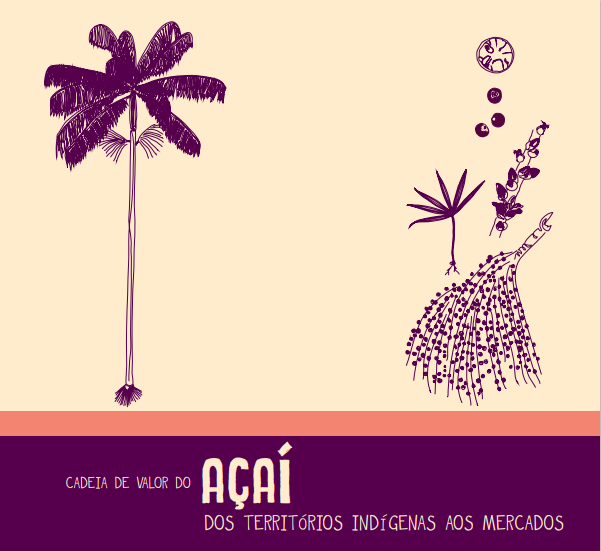
Through the Nossa Floresta Nossa Casa project, in partnership with Forest Trends, PPA and USAID, a collection of books was launched on the value chains of 21 indigenous peoples in 8 ITs that make up the Tupi Mosaic in Brazil, with the aim of developing economic initiatives that promote forest conservation. The books present concepts on indigenous territorial economic governance, challenges and opportunities for market access and specific activities underway in the territory.
In this edition, we have the value chain of Açaí, which comes from a palm tree typical of the Amazon region. With its name originating from the Tupi “yasa'i”, the fruit that cries, the açaí grows in bunches and has an important social and ancestral role for local traditional communities. In addition to being native to the region, it is also in the North where almost all national production of the fruit is concentrated, with 90% of all the extracted açaí produced in Brazil and 99% of the cultivated açaí (IBGE, 2020).